Intended Effect

Sean Mahan’s personal blog

  • About
  • Retiring My WASD V2 Keyboard

    Eons ago (~2013), my spouse suggested a mechanical keyboard as a gift idea for me. It was a good idea! By then I had pivoted from freelance miscellany to a steady programming job, and having nice tools for the trade seemed appropriate. I got a switch tester, I researched, and ended up selecting a WASD (spouse’s initial recommendation) V2 87-key / “tenkeyless” keyboard with Cherry MX Blue switches and a set of custom, etched-label keycaps in a custom blue/grey/orange color scheme.

    My 87 key WASD V2 on my perpetually messy desk back in 2013—taken on an iPhone 5s! The legends are laser etched into the keys, splitting the difference between starkly beautiful blank caps and usability by a typist who occasionally must hunt and peck. I still think the color scheme looks pretty good!

    At the time, the “buckling spring” IBM Model M was the consensus king of durable, classic keyboards with a great typing feel. Two intertwined aspects of that switch mechanism were said to be particularly important. First, that the switches had great tactile feedback when the spring “buckled” and snapped to trigger the contact; and second, that this tactile feedback was coincident with the switch activating (sending the “key got pressed” electrical signal). It was said that this allowed a frequent user to learn precisely how hard to press in order to activate the key without “bottoming out” and smashing the key to the low point of its available travel. The idea was that avoiding this shock would provide a gentler experience for your hands and fingers, and maybe even help to avoid repetitive stress injuries from typing.

    I had had some wrist issues from computer programming by that point, so for my keyboard I picked the Cherry MX Blue switches because they, too, had strong feedback that was at least close to (if not precisely coincident with) the activation of the switch. Finely-made, durable, German, Cherry switches; n-key rollover (many keys can be “down” at once”); a solid, flex-free build; support for alternative layouts (e.g. Dvorak); the ability to replace key caps sometime in the future; just the right amount of stylistic flair: these were the reasons to get a mechanical keyboard at the time. I’ve never dipped my toe into alternative keyboard layouts, but otherwise those were my personal reasons for feeling ready to get a mechanical keyboard.

    Typing Comfort

    It remained a familiar and comfortable typing experience through the decade that I used it. In the beginning, I was coming from typing on laptops or other low-profile keyboards, and I remember it taking a little time to adjust to the relatively deep 4mm travel of the switches and the various angles of the (Cherry? OEM?) profile keys. But it did come to feel pretty comfortable. I’ve had fewer bouts of wrist issues, but I’m not sure how much credit the keyboard deserves for that. For me, I think the more important changes were working at a desk at a good height, not working on a laptop on a couch, and switching to a vertical mouse. As predicted by internet skeptics, I never got so precise with my typing as to be able to consistently avoid bottoming out the blue switches. But I do like the click and switch activation being in the middle of the switch’s travel. I can go several keystrokes at a time without hitting the key all the way down, and the rest of the time I think the feedback helps my fingers to have at least slowed down by that point.

    WASD Etched Keycaps

    The keycaps turned out not to be very high quality. The etched legends felt rough, especially at first. I thought that some kind of finishing could have helped with this, but tellingly I haven’t noticed similar etched keycaps from any other vendors, so it may just be impossible to do nicely. I also spent the first few years with my desk in a challenging environment, where the keyboard was in almost daily, direct California sunlight. This, I believe, seriously discolored the keycaps (most noticeably the blue and grey ones). They looked disgusting and I worried that I must have especially filthy hand sweat or something. No amount of dish detergent or other soaps would remove the “stain”, though, and I eventually figured out that this yellowing is the behavior of additives and coatings meant to protect plastic from UV light.

    The best photo I could get of the probably-sunlight-caused discoloration of the original keycaps (and a bit of a look at the rough etched letters). These tumbled around in a junk box for a few years so, yes, they are also dirty.

    It was fun to pick a color scheme, to make some minor edits to the legends, and to have a keyboard that looked unlabeled like a simplified 3D rendering. At the time it felt like such customization was a major reason why one would buy a roughly $200 keyboard instead of just using whatever was lying around. But once I bought new keycaps the overall experience of the keyboard was much nicer.

    Domikey Keycaps

    In the Fall of 2020, the covid pandemic was still raging, my kids were not returning to in-person school, I was in full Super Dad mode trying to work from home while also making donuts and teaching kids to ride bikes and wrangling everyone up to Erie to hangout (masked!) on the beach. Depending on how that particular day was going, I was either ready to give myself a healthy little reward or so far gone that I was obsessively trawling mechanical keyboard forums to keep myself from screaming. So I bought fancy keycaps! I bought Domikey brand, doubleshot ABS plastic, SA* profile keycaps in the Classic Dolch color way. I love the “big centered letter” style of legends, the black/grey/red Dolch scheme felt like a subdued echo of my original grey/blue/orange, and I was sufficiently convinced by accounts on geekhack and r/MechanicalKeyboards to try the comparatively tall, sculpted, “SA” profile (or at least Domikey’s approximation of the canonical SA profile keycaps available from Signature Plastics).
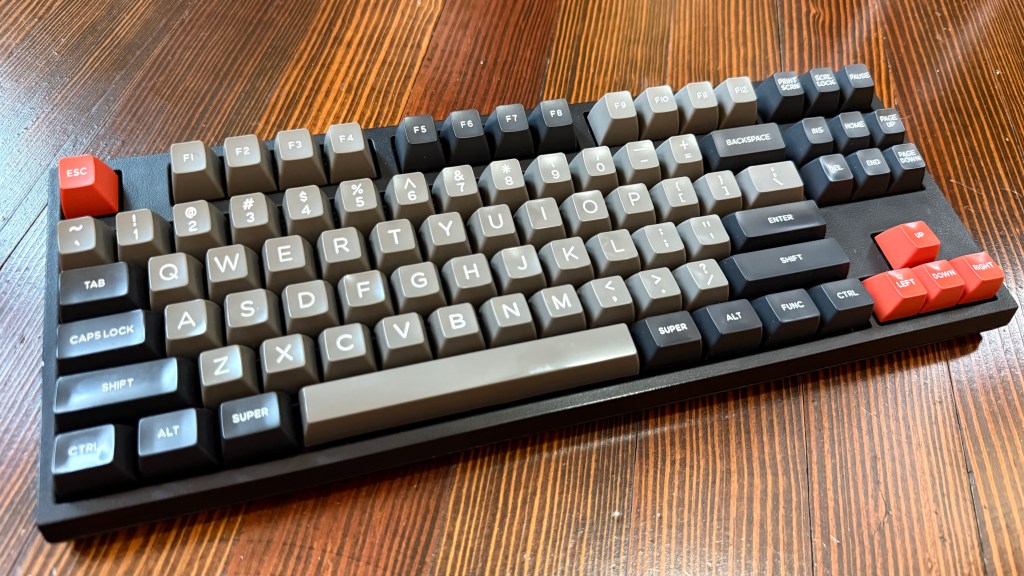
    My WASD V2 with the Domikey doubleshot ABS, SA-clone, Dolch keycaps—its final appearance before retirement. Sorry I don’t have a better glamour shot!

    I love these keycaps. I think they look fantastic. After an adjustment period, the tall, spherical, not-technically-SA-profile keycap shapes felt more comfortable and easier for me to touch-type with than the original ones. The most unexpectedly welcome change, though, was their effect on the sound of the keyboard.

    Click clack thock

    In 2024, many conversations in the mechanical keyboard hobby read like an audiophile forum, with people creating and eliminating voids, applying greases, adding weights, adding or removing layers of foam to prevent or permit the transmission of vibrations, and selecting materials from polycarbonate to brass in the pursuit of ever more precisely defined acoustic profiles. That’s fine and good, but not particularly appealing to me. And yet! The deeper, mellower sound of my keyboard with the new keycaps was such an improvement over the thinly clicky sound of the original keycaps, that I, too, may end up stuffing a keyboard with bandaids and kinetic sand someday.

    Wasdat Controller Board

    As part of the same 2020 “let’s upgrade this keyboard” impulse, I also bought a “Wasdat” (GitHub) replacement controller for it. This made the keyboard compatible with the powerful yet friendly VIA keyboard configuration software. Other than a tweak or two to the media keys, I didn’t end up taking much advantage of the flexibility this offered over the original configuration-by-DIP-switches. I will say that it was extremely cool and futuristic to pull a little circuit board out of its special little nook in the keyboard and replace it with a new one, and that ten minutes of feeling like I was an engineer on Star Trek was worth the ~$25. I’m not sure why WASD had the original controller on a daughterboard like this to begin with, but being able to easily upgrade it added to the professional feel of the keyboard. It’s probably not widely used, but I was disappointed to see that the successor V3 keyboards just have a soldered-in-place controller.
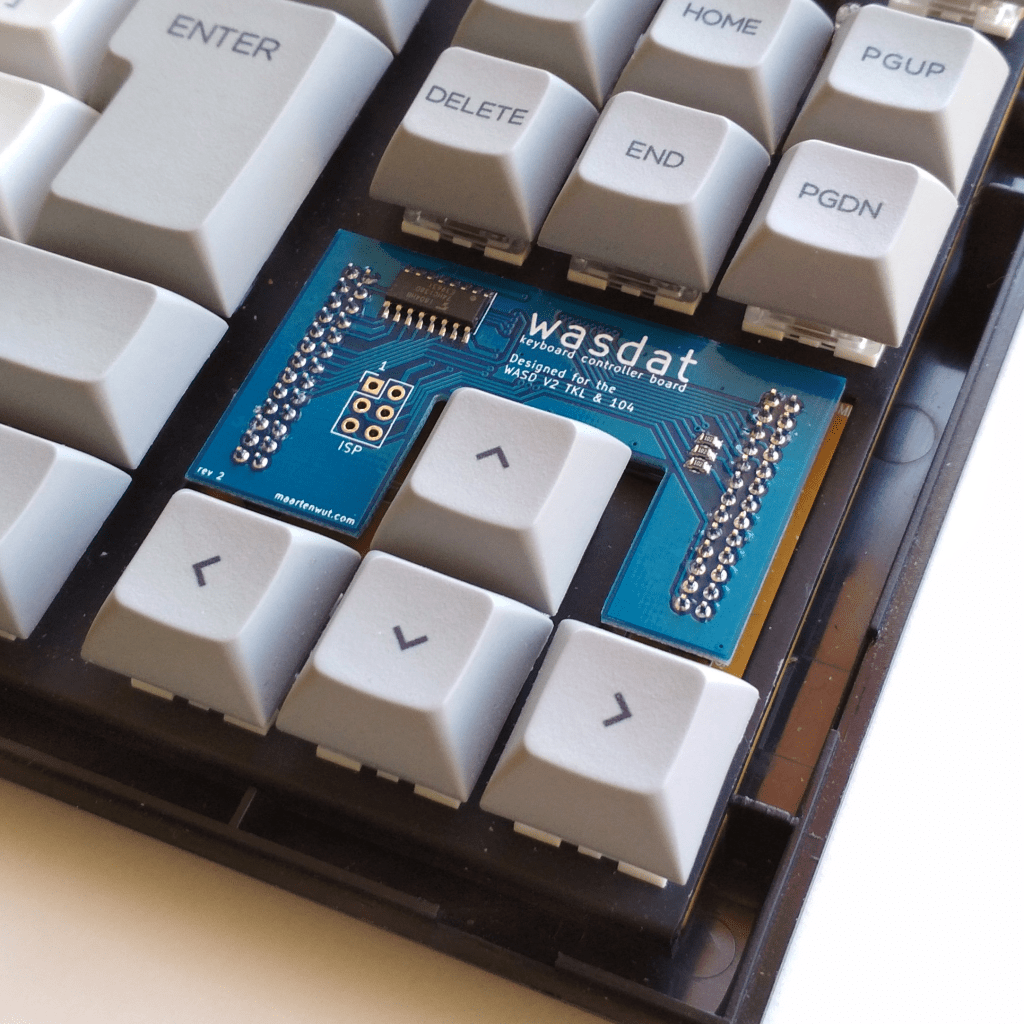
    A photo of the wasdat controller, taken from the anykeys website.

    Decline Phase

    By 2024, I started having issues with missed and doubled keystrokes. Inevitably, it seemed to affect keys I use frequently—Tab, “e”, and “o” were all pretty inconvenient to be unreliable. I was also growing tired of its clickiness—even its more muted, nicer-keycaps clickiness—while on Zoom calls. I later desoldered a few of the problematic switches and opened them up, and it looked to me like they were suffering from a decade of dust and hairs and other debris. I bought some new Cherry MX Blues to replace the problem switches with, but my crude soldering seems to have caused a problem where every so often a handful of keys will stop working for a minute or two.

    While I was in there, I did also try stuffing some sheets of foam into the case, and it sounded and felt a bit nicer! Honestly I’m still a little tempted to buy one of the fancy aluminum cases WASD now sells—the plastic case is held together primarily with tabs that snap into place, and of course I broke one when opening it up to do the controller swap a few years back. This keyboard is sentimental to me, and in some ways I really like the idea of having and using a durable tool that’s old enough to attend middle school.

    But I’m also worried that the “dead keys” issue is because I damaged the circuit board soldering in new switches. I don’t think computer programming is about typing all day, but I do enough typing that I need my keyboard to be a tool that I can rely on. So in the end, I did buy something new, but that’s a subject for a different post.
    intendedeffect

    May 15, 2025
    Electronics, Keyboards, Programming
    mechanical keyboards, Programming
  • Shortcut for Randomizing Reminders List Order

    Every so often I end up making a new list of low-priority things I have been meaning to do. I often do this in the Reminders app on iOS, and I always do it with a plan to regularly check that list and, as I imagine it, occasionally spot some little task that feels just right in the moment. Instead, I forget about those lists, I only rarely complete those to-dos, and then only when something else brings one of them to mind. As the calendar turns over, even I can’t resist a little bit of a hopeful attempt at a productivity hack, so I’m going to see if I can set myself up for more success in 2025.

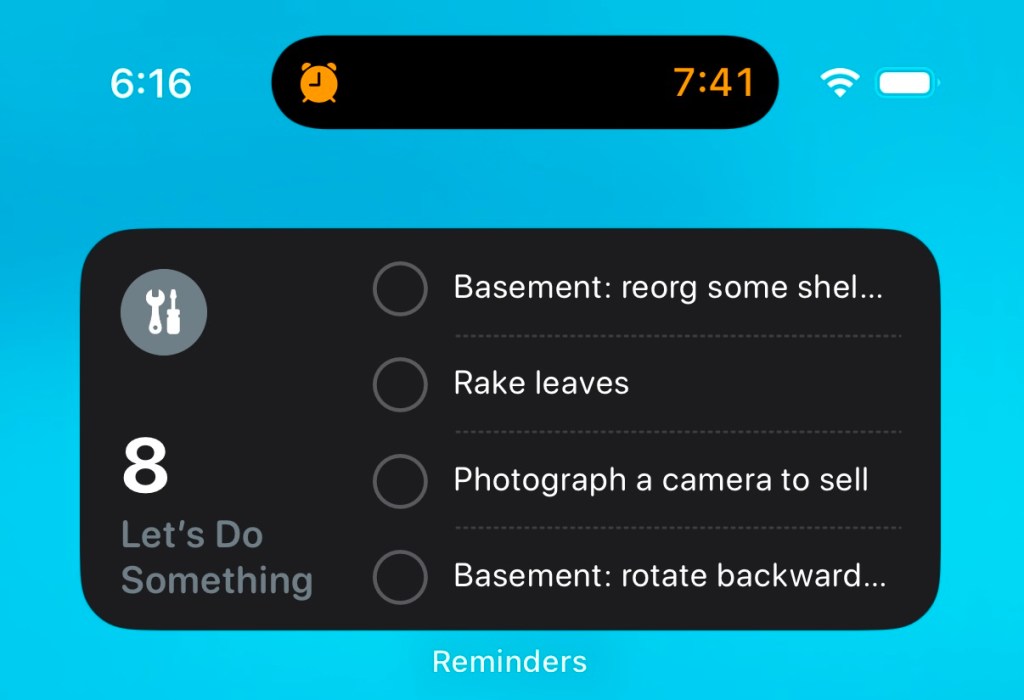
    My reminder widget, early in the morning before I’ve officially woken up.

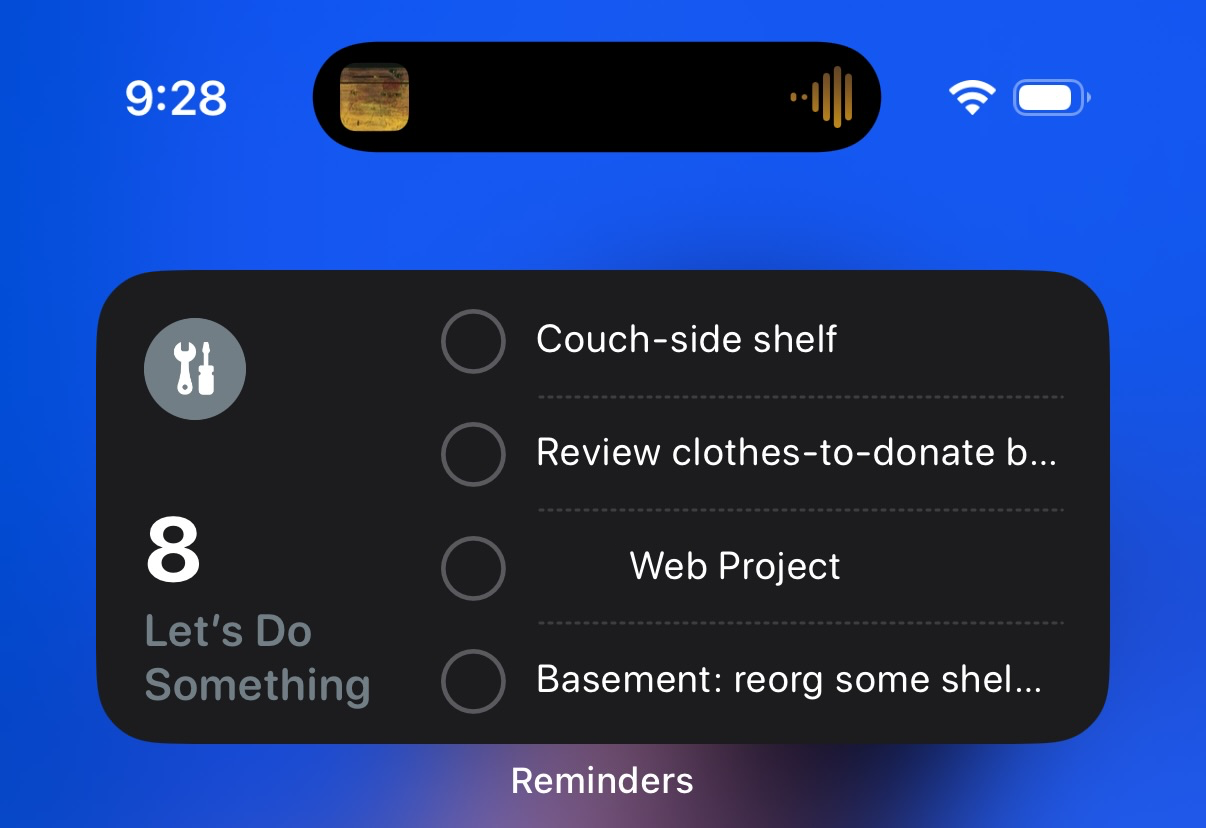
    What I’m doing is putting a large widget on my phone’s home screen with the current iteration of this list. The point, for me, is that the full list includes a relatively large number of varied things to do, and that these tasks have no particular priority or order in which they should be done. I want to glance at this list one day and think, “yeah I can bundle up some clothes to donate”; on another day decide to put up some shelves; and on yet another feel up to preparing some cameras for eBay.

    Later that day, it shows a (mostly) new set of tasks.

    But the widget only show four items, and neither the Reminders app nor its widget has a “shuffle” mode. I needed a way to randomize the order of this list so that I would be presented with a different set of four items every day or so. I created a simple Shortcut to do that. Here’s what it does:

    • Shortcuts has a built in method to get items from a Reminders list. Even better, the Sort option for this lets you sort them in random order. So already we’ve got our randomized list of pending to-do items!
    • The problem is preserving that random order: there doesn’t appear to be a way to have a Shortcut set the manual sort order of a list of reminders.
      • My first attempt to solve this was to iterate through the randomized list, adding a new copy of each to-do item to the list and deleting the original—thus rebuilding the list from scratch each time. But frustratingly if understandably, it’s impossible to have a Shortcut delete Reminders items without prompting the user to approve the deletion each time. Completing each item instead of deleting it would mean amassing a huge pile of duplicate completed items in the list, which felt wrong.
      • This means we have to find a way to save the randomized order by only editing the existing items. The Due Date field is a supported Sort field in the Reminders app, and it can also be set by a Shortcut. I’m not using Due Date for this list of low-priority / no-due-date tasks, so I’m free to use it as a blunt way to order reminders. So now I loop through the randomized list of reminders, and set the Due Date for each one to be:
        [current date] + (120 + [“repeat index” of the randomized list]) days
        This ends up setting one item to be due in 121 days, another in 122 days, etc, etc. I picked 120 days as an interval far enough out that I won’t usually be bothered by seeing these reminders in the Calendar app.
    • That’s it for the script, so now we just need a way to run it regularly. I use a daily sleep schedule on my phone, so in the Automation tab of Shortcuts I already had a “When Waking Up” entry. I set this to run my Shortcut.

    This means that the list gets reordered soon after I wake up, but the widget itself doesn’t update immediately. For me that’s OK; again, none of these tasks are time-sensitive and I just want to see a new set of them out of the corner of my eye every so often. A few days in, I can confirm that the technical side of the system works. I haven’t actually done anything from the list yet; if anything, so far this has only prompted me to add more reminders to it. Cynically, I think most productivity hacks only function to perpetuate themselves, so if that’s all this accomplishes I can’t say I’ll be surprised.

    Screenshot of the Shortcut

    But hope springs eternal! If you’d like to try this, here’s a link to the Shortcut—you’ll need to set the Reminders list to your own list to use. I’ll try to revisit this is 6 months or so to report on how my completion count is looking.

    intendedeffect

    January 5, 2025
    Programming, Uncategorized
    apple, productivity, shortcuts, tech, technology
  • Farewell, Penn Ave Satellite Dish

    Taken in late 2023. Nikon FE2 Nikon Series E 50/1.8 Kodak Plus-X

    I never knew what this satellite dish at the corner of Penn Ave and Mathilda St was. The aggressively unlabeled building it was next to suggested something more prosaic than the TV or radio station that I liked to imagine was broadcasting, for some reason, from a ground-level parking lot.

    Even in the generally dense east end, Pittsburgh has a real mixture of roughly 60+ year-old pedestrian-focused street-fronting density, and somewhat newer attempts to get with the later 20th century times by creating a more car-friendly landscape. Even now, when most of the architects, neighborhood groups, and city planners would rather skip devoting any more surface area to asphalt, we sometimes get stuck with the decidedly suburban-looking First National Bank branch newly built at the corner of Penn and Negley Avenues. So it was nice that this fairly ugly building with small windows and a large surface parking lot could at least offer a little visual interest in the form of a surprisingly large satellite dish. I’ll miss walking by it.

    Taken in mid 2024. Agat 18K, Kodak Pro Image 100

    intendedeffect

    October 20, 2024
    Uncategorized
  • Unboxing the World

    I haven’t listened to many “general interest” podcasts (or radio shows, or YouTubers) in a while—you know, This American Life, Radio Lab, and their less-famous or non-NPR or more-niche-specific analogs. I’m a curious person, I like learning about things, and I will even admit to enjoying telling other people all about the things I know without them necessarily inviting such a lecture. So what happened?

    First, another question: are “unboxing” videos still a a thing? Off the top of my head, I think of them as having started around the time of the early iPhones. They were videos of someone taking a new and generally high-end product out of its packaging. Usually there would be some light editorializing about materials, a dash of plastic film ASMR, and sometimes a brief look at the product itself. But the extent to which these videos did resemble a review was strictly for the purpose of communicating the relative pleasure of experiencing the object purely as a product and not as a tool. That format meant that the only qualification for creating these videos was simply having that hot product before most other people did, and the only thing these videos delivered was the thin, vicarious experience of opening the box.

    To me, unboxing videos have always seemed insane. The host was invariably someone without much specific insight into the product category, with YouTube audience thirst oozing out of every pore, and sometimes an undercurrent of desperation spurred by the uncertainty of whether the views will pay enough to justify the expense of purchasing the product. I absolutely recognize the nerdy impulse to dive headfirst into as much content about your interests as possible, but unboxing videos always seemed like a pure “spoiler” to me: congratulations, now if you buy that product yourself, your own reactions will slip into a track already carved out by someone named Josh who is not a fellow obsessive but instead just someone with $1000 and an ambition to make a popular video.

    So, yes, to tie this back together, there’s a kind of reporting/essaying common to those podcasts that feels too much like “unboxing the world” to me. Millions of young people will no longer get to have the experience of bumping into the term “desire lines” unprepared! Why? Because there are fleets of self-consciously thoughtful people, armed with microphones, plying the seas of emerging subcultures, niche industries, and overlooked places for anything that could feel like a discovery. Unlike when a friend tells you about something they have recently encountered, each overturned rock is offered with a kind of public act of introspection that seems to close the subject off to further contemplation even while it offers no conclusions. The personal, almost confessional tone of these podcasts becomes more quietly unsettling with each additional episode: learning about epigenetics just blew your mind last week, and now talking to someone from a failed 1960’s commune has you once again awestruck by the complex beauty of existence? Is this a meta-narrative about a personality disorder?

    As I have gotten older, moments of genuine wonder—times when something new lets you glimpse a terrain of possibilities—have gotten more rare, and consequently more precious to me. As you age there is more that you (think you) already know, and you also must put in more work to maintain the curious and open mindset that enables these experiences. So I think the strength of my reaction is partly driven by disgust at the formulaic bulk commercialization—however well-intentioned and poorly-compensated—of this kind of feeling. But primarily I stopped listening because however many of those nuggets are still unknown to me, I would prefer to experience discovering them by myself or with friends.

    intendedeffect

    July 20, 2024
    Uncategorized
  • Old Millenials, LLMs, and the Internet

    I have been thinking a lot about the internet (the web?) lately, especially vis-a-vis LLMs, and I keep trying and failing to write down my thoughts. So rather than keep attempting to wring a coherent argument out of myself, I’m going to take the coward’s way out and write up some loosely-connected bullet points.

    • I’m approximately 40, and nearly all of the decision makers driving the recent AI/LLM explosion are roughly my age or older. I think that if you experienced the late 90’s through iPhone explosion of the web—if you were old enough to experience a need and then (still) flexible enough and curious enough to dive into meeting it with new technology—then LLMs can feel like the apotheosis of the internet. If you are old enough, then you have sat with friends wondering what actor was in a film, or what the name of a musician’s side project was, or how to make guacamole, and been entirely unable to answer the question in that moment. And as time went on you would have experienced asking Lycos or Yahoo or AltaVista or Google about more and subtler things, and been delighted as more and more of them had useful results. I think the magic of living through that transformation established a kind of trust in the internet as a communal body of knowledge (even if most of those now-40-year-olds were also posting nonsense on Something Awful or 4chan).
    • That content was coming from a wide variety of sources, too. There were central consolidators of information like Wikipedia and The IMDB, but it was also very common to find your answer on someone’s personal webpage on Geocities or Angelfire, or on a dedicated community / fansite, or a phpBB forum, or one of seemingly innumerable university professors’ websites. My recollection is that simply making a website—any website—was fun, and novel, and seemed like a way to build a presumed-to-be useful skill, so people would set out primarily to learn HTML and only secondarily (at least at first) to share their knowledge about fish keeping or making sourdough or the lyrics of The Doors. The hosting was free, the time was an investment, and beyond “maybe put AdWords on it” there wasn’t much of a business case to be made and thus little in the way of an invisible hand forcing consolidation in the market to provide information about the South Jersey ska-punk scene.
    • Now much of that kind of personal content has moved within platforms. Some of those, like Reddit or Fandom, are within view of a Google search, but the most devoted “interest community” activity is now enclosed within Instagram, Facebook, Discord, Telegram, TikTok, etc, etc. Self-hosting an open community on the internet has a lot of challenges (technical, financial, moderation, etc) so this is pretty understandable, but it feels like a tragedy to me. To whit, film photography is seeing a resurgence, but if you Google for help with your parent’s old camera the best results will probably be on Flickr from more than a decade ago, because the relevant subreddits are more casual and there’s no easy way to find the right Discords and Facebook Groups when you are new to the hobby.
    • Personally, I think Google would be better off today if they had invested in solving those problems to enable people to keep such conversations happening out in the open. And not only for LLM purposes; search results are terrible now partly because there is so much keyword spam content, but also because there’s scant new hobbyist content (leaving only the 2010 Flickr threads about that hand-me-down Nikon). There is, as people have found, Reddit, but attempts to game Google through spam on Reddit are already testing the dedication of volunteer moderators.
    • I hope that LLM-mania will prompt the tech giants to encourage a return of the kind of self-consciously open knowledge sharing that flowered on the early web—and to be clear, I hope they can encourage that by creating financial support for that knowledge sharing in addition to relying on good UX and public spiritedness. But Google has YouTube, Meta has Facebook and Instagram and Threads, and for the moment OpenAI has ambiguous laws and an Uber-style habit of taking first and only asking for permission later if forced to. While it is true that advances in AI make it easier (or at least possible) to get value out of existing pools of data, I think there is something almost mercantilist in the way companies are focused solely on the value of their proprietary datasets. So I don’t think a Google or a Meta will feel that they have anything to gain from enabling the creation and sharing of data that is not exclusive to their own use.
    • Reporter James Surowiecki’s The Wisdom of Crowds turned 20 years old this May. I’ve never read it! But I did it hear highly condensed accounts of it in both more and less formal presentations in the Bay Area in the years immediately following its 2004 release. Such crowds were at their wisest when averaging a number, as in guessing the weight of an ox at a county fair (the anecdote which invariably accompanied any mention of the book), or assessing the quality of a restaurant. So for a time people were very interested in things like tagging systems that might offer a way to make anything from LinkedIn resumes to Flickr photos roughly reducible to something that could be navigated and ranked with simple arithmetic.
    • I’m no machine learning PhD, but as I understand it the current explosion of LLMs is enabled by a combination of techniques going back to the likes of Word2Vec that can represent text (among other things) as many-dimensional grids of numbers, and the increasing power of graphics cards to process more of those matrices in much less time. So now an LLM can summarize a page of text, and it is similarly a matter of math. But at a product level, I think people (likely my age!) are mistakenly imagining that recipes can be aggregated with the same kind of deterministic Excel math used to summarize movie review scores. One prank pizza recipe can cause subtler havoc than one prank product rating.
    • For now, there are broadly two ways that an LLM can answer your question.
      • One, is for the LLM to answer the question “itself”, drawing from its base dataset (which we can shorthand as “the entire web”) and modulated by whatever training or fine-tuning it received (shorthand as showing it example question/ answer pairs, or people giving proposed answers a thumbs up or thumbs down). This is fun and impressive, because it seems like the internet has become sentient, it feels like talking to an all-knowing demigod, and at its best these answers appear to distill the entirety of human knowledge about a subject into a concise response. On the other hand, because the answer is being sieved out of such an enormous soup of data, these responses sometimes exhibit inaccuracies that weren’t present in the source material.
      • The other way (called Retrieval Augmented Generation, or RAG) is for a process to search a body of content for text likely to have the answer, and then have the LLM answer the question drawing only from the text of those sources. This tends to create responses that hew closer to the source text, but it’s a bit less magical because reading a Wikipedia page and summarizing the first paragraph is something most people could just do themselves, and seeing the sources cited reminds people of how much they may not trust Wikipedia, or a given newspaper, or Reddit, or a blogpost.
    • Something that I imagine is tantalizing to founders about the Wisdom of Crowds framing is that each individual contribution is presumed to be almost worthless—so Yelp, for example, is providing more value by aggregating than you do by writing your individual review. I like the idea of a universe where there can be millions of individual pages and conversations about (say) film photography, but I think that (perhaps outdated!) view of the internet may play into the idea that none of those non-professional sources are particularly valuable individually, and that an LLM trained on them summarizing an answer out of so much photography text soup is what is really providing value. Meanwhile, if there really are only a handful of sources to draw from, it becomes clearer that they are the actual resource, that they are providing the value—and that they should probably be paid.
    • I will say that I think both answering strategies are and will continue to be useful in practice, and that different people may want different kinds of answers to the same questions—I may want the zeitgeist-thru-LLM’s quick answer to what temperature to bake salmon at, but lots of context around what is the best laser printer; you may want the opposite. But if the authentic human conversations remain in closed communities (maybe even moreso in flight from AI), and the display-ad websites disappear along with their Google traffic, and if everywhere on the internet is flooded by okay-ish AI-generated empty content, then I don’t know where new source material is going to come from. It’s genuinely exciting that we’ve achieved the early 2000’s goal of creating the greatest interactive encyclopedia ever (boy did computer nerds love talking about the Primer in Neal Stephenson’s The Diamond Age). But the information ecosystem of the internet will have to evolve if that encyclopedia is going to continue to be updated into the 2030’s.

    intendedeffect

    May 26, 2024
    Uncategorized
1 2 3 4
Next Page→

Website Powered by WordPress.com.


Loading Comments...
 

    • Subscribe Subscribed
      • Intended Effect
      • Already have a WordPress.com account? Log in now.
      • Intended Effect
      • Subscribe Subscribed
      • Sign up
      • Log in
      • Report this content
      • View site in Reader
      • Manage subscriptions
      • Collapse this bar